St John's Co-Cathedral Valletta: Caravaggio Masterpieces & Baroque Marvel
St John's Co-Cathedral stands as one of Europe's most remarkable baroque monuments and Malta's single most important cultural attraction. Hidden behind an austere limestone facade on a quiet Valletta street, the cathedral's interior reveals an explosion of artistic brilliance that consistently leaves visitors astonished. From the moment you step inside, you're surrounded by every surface covered in ornate carvings, gilded decorations, and masterful paintings that took over a century to complete. For anyone planning to explore Valletta's historic streets, this cathedral demands your first morning.
The cathedral's significance extends far beyond its visual splendour. This is the final resting place of Grand Masters who ruled Malta for nearly three centuries, the spiritual heart of the Knights Hospitaller, and home to Caravaggio's largest and only signed painting. When you visit St John's Co-Cathedral, you're walking through 450 years of Mediterranean history, art, and devotion. It's an experience that perfectly captures why Malta's attractions rival any European capital.
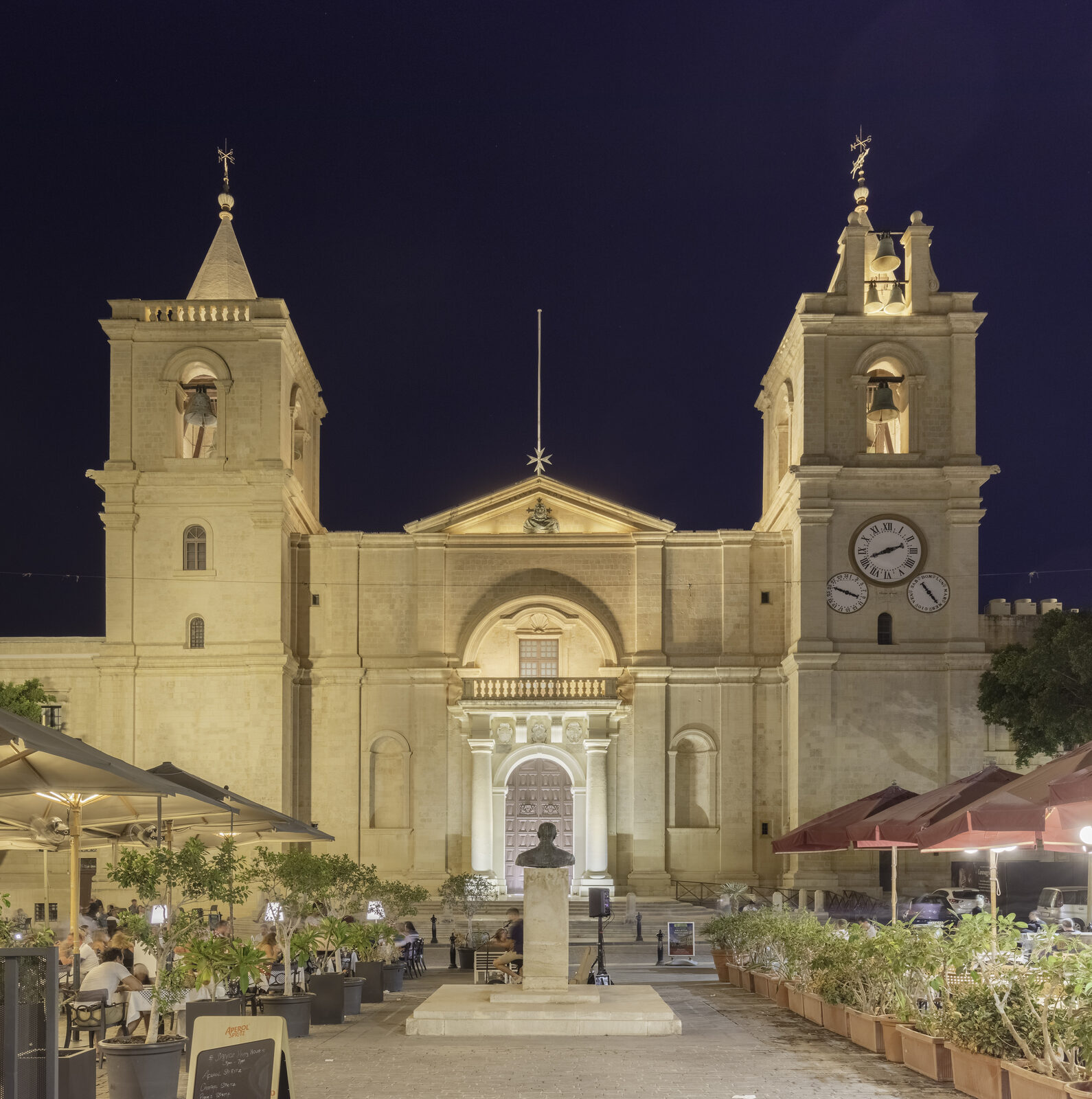
St John's Co-Cathedral, Valletta, illuminated at night, viewed from St John's Square
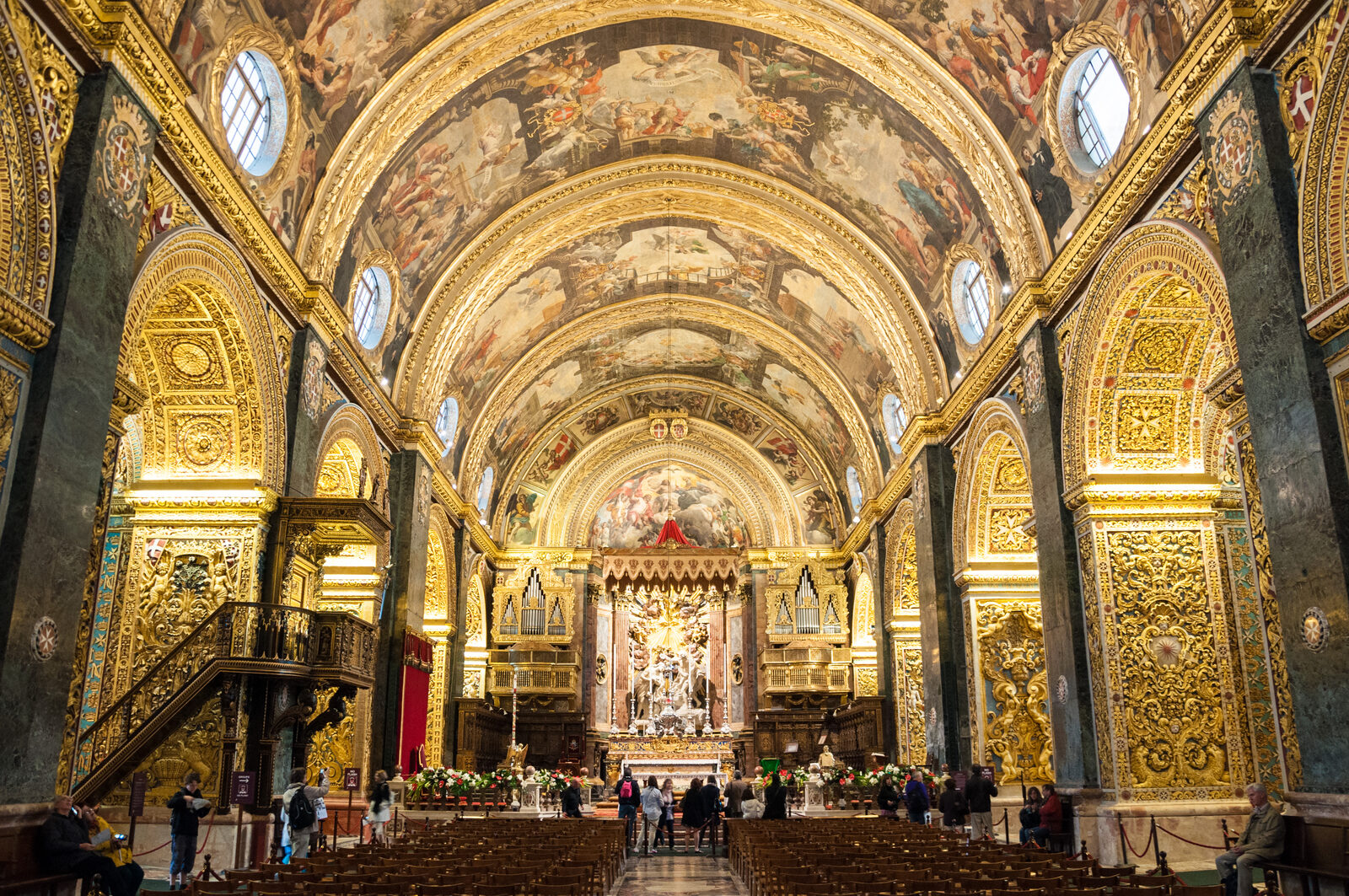
The nave of St John's Co-Cathedral, Valletta, showing the gilded Baroque interior
The Knights of Malta: Who Built This Cathedral, and Why
To understand St John's Co-Cathedral, you first need to understand the extraordinary order of warrior-monks who built it. The Order of St John, known today as the Knights of Malta and formally as the Sovereign Military Order of Malta, began life not in Malta at all, but in 11th-century Jerusalem, founded to care for sick and injured pilgrims arriving in the Holy Land. Over the following centuries, the Order transformed into something far more unusual: part hospital charity, part naval power, part religious brotherhood, sworn to poverty, chastity and obedience, yet commanding fleets and fortresses across the Mediterranean.
After losing Jerusalem, the Knights relocated to Rhodes, where they held out against the Ottoman Empire for over two centuries before finally being forced to surrender the island in 1522. For eight years the Order was effectively homeless, until 1530, when Holy Roman Emperor Charles V granted them Malta, in exchange for a rent of precisely one Maltese falcon, delivered annually on All Saints' Day. It's a genuinely true detail, not folklore, and one that later inspired the title of a rather more famous piece of 20th-century fiction.
The Knights' most famous moment on Malta came in 1565, when a vastly outnumbered garrison withstood a four-month Ottoman siege (the Great Siege of Malta), in what's still regarded as one of the most significant military stands in European history. Victory secured the Knights' hold on the island and gave Grand Master Jean de Valette the confidence to build an entirely new, purpose-fortified capital city, named Valletta in his own honour. St John's Co-Cathedral, commissioned soon after in 1572, was built as the Order's conventual church, the spiritual and ceremonial heart of the Knights themselves rather than a public parish church, which explains why its interior is so extraordinarily rich: every langue, or national division of the Order, competed to decorate its own chapel more lavishly than the last.
The Knights ruled Malta for 268 years, until Napoleon expelled them in 1798 on his way to Egypt. But the Order itself never disappeared. Today, as the Sovereign Military Order of Malta, it still exists, headquartered in Rome, holding permanent observer status at the United Nations, issuing its own passports and coins, and running hospitals and humanitarian relief operations in more than 120 countries. It is, remarkably, one of the oldest continuously functioning institutions in the world.
That legacy is still visibly and deliberately celebrated in Malta today, nowhere more so than in the identity of the island's own national airline. KM Malta Airlines, which launched in March 2024 as Malta's flag carrier, uses "Sky Knight" as its official radio callsign, a direct nod to the Order that shaped the island's history. The airline has confirmed that its IATA code, KM, carries the same intentional reference to the Knights of Malta. It's a small but fitting detail: the very same knights who built the cathedral you're reading about now lend their name and spirit to the aircraft carrying today's visitors to see it, flying direct from London Heathrow and Gatwick as part of VisitMalta.co.uk's Malta holiday packages.
What Makes St John's Co-Cathedral Special?
The contrast between exterior and interior makes St John's Co-Cathedral unlike any other church in Europe. Architect Girolamo Cassar deliberately designed the outside to be fortress-like and plain, fitting for a church built by warrior monks who had just survived the brutal Great Siege of 1565. But once inside, you encounter what many art historians consider the most concentrated display of High Baroque decoration anywhere in the world.
Every centimetre of the cathedral's interior serves a purpose. The elaborate marble floor comprises over 400 tombstones marking the burial places of Knights from across Europe, each an individual masterpiece of inlaid marble showing coats of arms, symbols of mortality, and Latin inscriptions. Above your head, Mattia Preti's eighteen ceiling paintings completed between 1661 and 1666 depict scenes from the life of St John the Baptist with dramatic intensity that influenced European art for generations. The eight side chapels, each belonging to one of the Knights' langues (national divisions), compete in artistic splendour, essentially eight small churches within the larger cathedral.
However, the cathedral's supreme treasure awaits in the Oratory: Caravaggio's 'The Beheading of St John the Baptist', painted in 1608. Measuring an immense 3.7 metres by 5.2 metres, this work represents the peak of Caravaggio's revolutionary technique: dramatic lighting, psychological intensity, and brutal realism that changed the course of Western art. It remains the only painting he ever signed, and he did so by writing his name in the blood flowing from the Baptist's severed neck. Alongside hangs his equally powerful 'St Jerome Writing', making Malta home to two works that attract art pilgrims from around the globe. For those seeking Malta cultural holidays, St John's provides an unmissable centrepiece.
History of St John's Co-Cathedral
The Knights of St John commissioned St John's Co-Cathedral immediately after surviving the Great Siege of 1565, when Ottoman forces sought to eliminate their Mediterranean stronghold. With Malta secure and a new fortified capital rising at Valletta, Grand Master Jean de la Vallette ordered construction of a conventual church worthy of the Order's gratitude and military pride. Girolamo Cassar, Malta's foremost architect who had trained in Rome, designed the building between 1573 and 1578.
The cathedral's original interior was relatively austere, reflecting the Knights' military discipline. The transformation began under Grand Master Nicolas Cotoner (1663-1680), who commissioned Calabrian artist Mattia Preti to decorate the nave. Preti devoted five years to painting the vault, working directly onto the stone surface using a technique that has preserved his masterpieces remarkably well over 350 years. Each Grand Master subsequently sought to outdo predecessors, resulting in the gradual enrichment of the langue chapels with precious marbles, silver gates, and paintings by leading European artists.
Caravaggio arrived in Malta in 1607, fleeing Rome after killing a man in a brawl. Seeking rehabilitation and hoping the Knights might use their influence for a papal pardon, he painted prolifically during his fourteen months on the island. The Grand Master was sufficiently impressed to make him a Knight of Obedience, an honour Caravaggio lost just months later when he assaulted a senior Knight and fled Malta in disgrace. Nevertheless, his paintings remained, eventually becoming the cathedral's most celebrated possessions.
The church received 'Co-Cathedral' status in 1816, placing it on equal footing with the ancient cathedral at Mdina, hence the unusual designation. Since Malta's independence in 1964, St John's has been managed by the St John's Co-Cathedral Foundation, which undertakes continuous restoration to preserve this irreplaceable heritage for future generations. As part of UNESCO-listed Valletta, the cathedral represents one of Europe's most significant Baroque monuments.
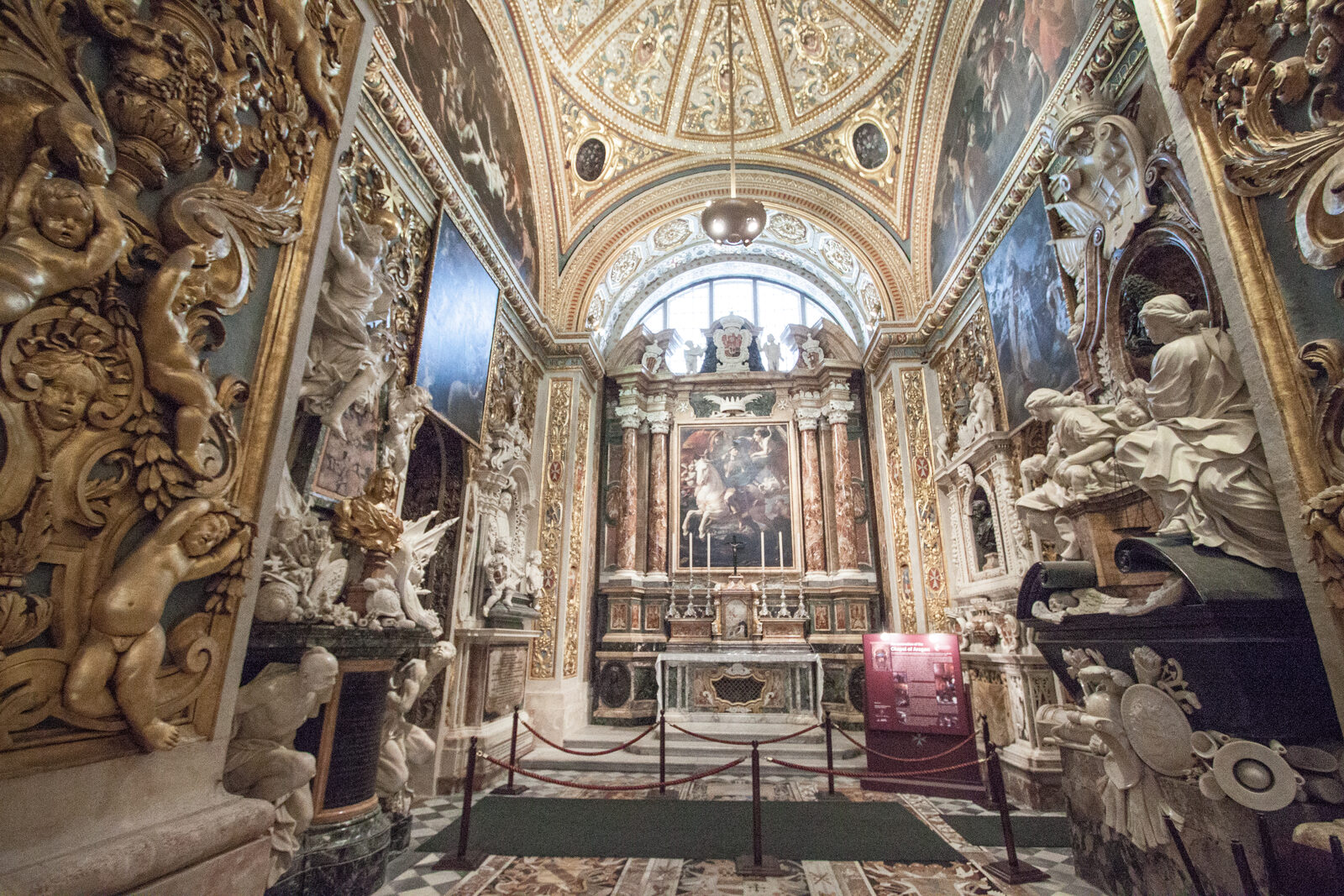
Gilded Baroque detail inside St John's Co-Cathedral
Caravaggio in Malta: The Painting, the Painter, and the Scandal
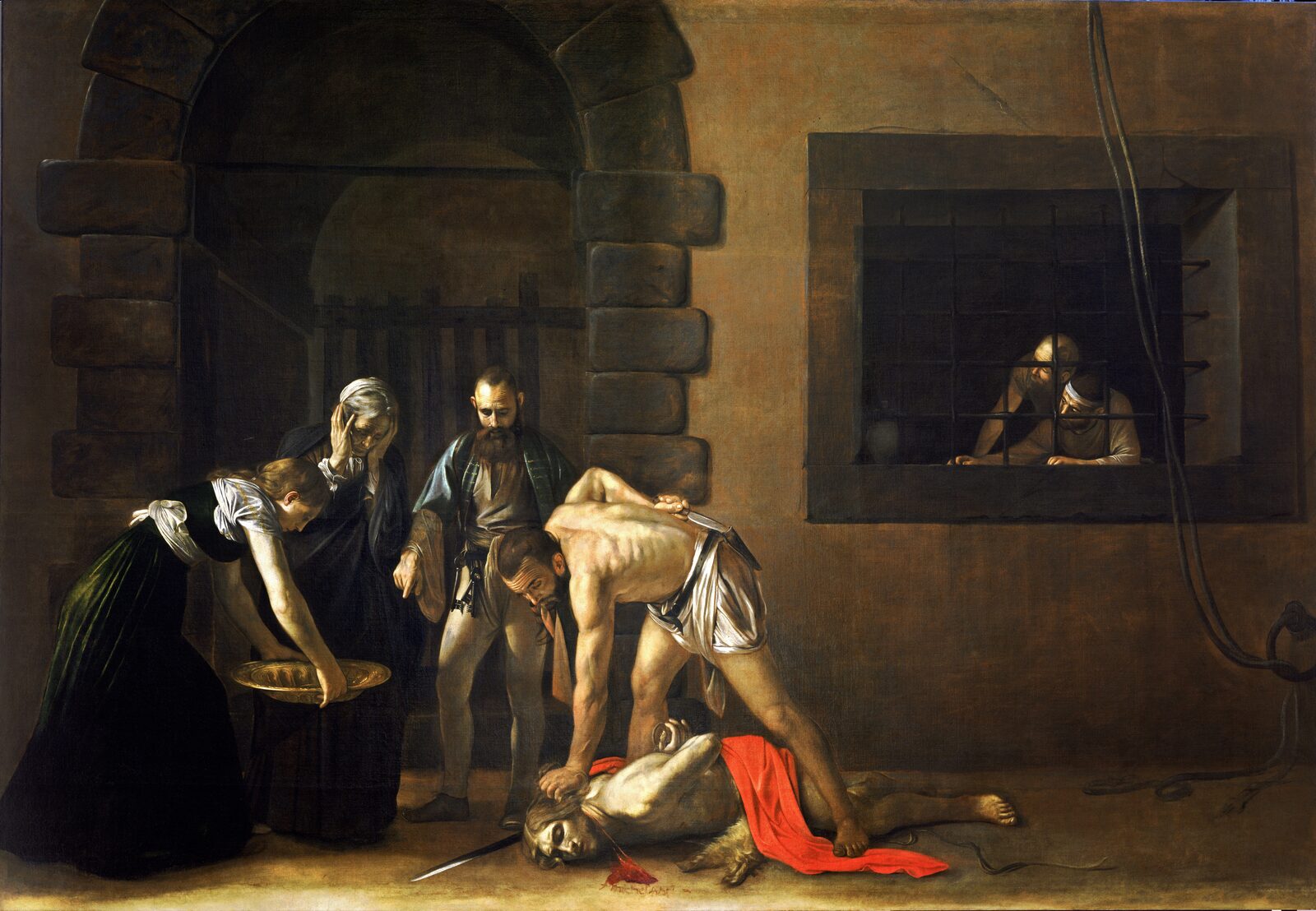
The Beheading of Saint John the Baptist by Caravaggio (1608), Oratory of St John's Co-Cathedral
Michelangelo Merisi da Caravaggio arrived in Malta in July 1607 as a fugitive. A year earlier in Rome, he had killed a man named Ranuccio Tomassoni in a duel and fled the city with a death sentence hanging over him. Malta offered something valuable: the Knights of St John could confer a knighthood, and a knighthood might eventually persuade the Pope to grant a pardon. Grand Master Alof de Wignacourt, dazzled by the artist's talent, made the extraordinary decision to knight him as a Knight of Obedience, an honour almost never given to someone without noble birth.
In just fourteen months on the island, Caravaggio painted prolifically, and his masterpiece from this period still hangs exactly where it was created: The Beheading of Saint John the Baptist, completed in 1608 for the Oratory of St John's Co-Cathedral. At 3.7 by 5.2 metres, it is Caravaggio's largest surviving work, and it depicts the moment of the Baptist's execution with a psychological brutality that had never been attempted at this scale before: the resigned stillness of the victim, the executioner reaching for his knife having already struck the first blow, Salome's servant girl holding out a golden platter, and an old woman clutching her head in horror. It is also, uniquely among everything Caravaggio ever painted, signed: he wrote his name in the blood pooling from John's severed neck, "f. michelAn.o," identifying himself as a "fra," a brother of the Order. No other confirmed Caravaggio painting carries his signature at all.
A companion piece, Saint Jerome Writing, hangs nearby in the same Oratory, smaller and quieter, showing the elderly saint absorbed in translating scripture by candlelight. Together the two paintings represent the peak of Caravaggio's brief but explosive time on the island.
The knighthood didn't last. Within months, Caravaggio was involved in a violent assault on a senior knight, was imprisoned in Fort St Angelo, and then astonishingly escaped, scaling the fortress walls according to contemporary accounts. The Order formally stripped him of his knighthood in absentia, expelling him, in the Order's own words, as "a foul and rotten member." He fled first to Sicily, then Naples, and died in 1610 near Porto Ercole on the Tuscan coast under circumstances still debated by historians, most likely fever or infection, possibly connected to a violent altercation, though lead poisoning from his own paints has also been suggested. He never received the pardon he had come to Malta seeking.
The painting's own history since then has had its own drama. In December 1984, Saint Jerome Writing, the companion piece, was stolen from the Oratory, cut from its frame in a theft that shocked Malta and the wider art world; it was later recovered. The Beheading itself underwent significant restoration in the late 1990s, cleaning centuries of accumulated grime and revealing detail in the shadows that had grown almost illegible. Today, both paintings remain on public display in the Oratory, on the same walls the Order originally commissioned them for, genuinely rare for major Old Master works, which more typically end up relocated to museums far from their original setting.
The Nine Chapels: A Cathedral Within a Cathedral
Flanking the nave are eight side chapels, each belonging to one of the langues, the national divisions the Knights of St John organised themselves into, based on where individual knights came from within Europe. Every langue funded and decorated its own chapel independently, and the result is less a single unified cathedral interior than nine smaller, fiercely competitive masterpieces sitting side by side. For anyone planning a Valletta city break, walking the full length of both sides of the nave, chapel by chapel, is genuinely one of the best half-hours you can spend in Malta.
Chapel of Provence
Dedicated to St Michael, the Chapel of Provence holds monuments to Grand Masters Jean Lascaris and Antoine de Paule, both from the Provençal langue. Most significantly, its crypt contains the tomb of Jean Parisot de Valette himself, the Grand Master who led the Knights through the Great Siege of 1565 and gave his name to the city built afterward. Standing here, in front of the tomb of the man responsible for Valletta's very existence, is one of the more genuinely moving moments available to anyone exploring Malta's history firsthand.
Chapel of Auvergne
The Auvergnat knights, drawn from central France, decorated their chapel with the same competitive spirit as every other langue, contributing to the cathedral's overall reputation as one of the finest concentrations of Baroque art anywhere on a Malta holiday itinerary. Like its neighbours, the chapel reflects both religious devotion and a very human desire among the Knights to outdo one another in splendour.
Chapel of France
The French langue's chapel sits among the cathedral's grandest, reflecting France's historical prominence within the Order. Many visitors flying in with KM Malta Airlines find the French chapel a natural point of comparison to Baroque architecture back home, given how directly it echoes decorative styles found across France's own great cathedrals of the same period.
Chapel of Italy
Given Italy's centrality to the Order's history and the Knights' own deep connections to Rome, the Italian langue's chapel showcases particularly fine marble work, befitting the wealth and prestige the langue held within the Order's hierarchy. It's a strong argument for treating St John's as a genuine centrepiece of any luxury Malta holiday, not simply a quick stop between beach days.
Chapel of Aragon
Home to an altarpiece by Mattia Preti depicting St George slaying the dragon, the Chapel of Aragon represents the Spanish and Catalan knights within the Order. Its imagery draws directly on the same medieval chivalric tradition that shaped the wider Knights Hospitaller story, connecting Malta's baroque interior back to centuries of European crusading history well before the Order ever set foot on the island, a thread worth following for anyone combining Valletta with an afternoon in Mdina, Malta's other great historic capital.
Chapel of Castile, León and Portugal
Dedicated to St James, this chapel features an altarpiece by Mattia Preti alongside two substantial mausolea, commemorating Grand Masters António Manoel de Vilhena and Manuel Pinto da Fonseca, two of the more consequential figures in the Order's later Maltese history, both remembered elsewhere on the island through buildings and fortifications that still carry their names. Visitors deciding where to stay in Malta will likely encounter Pinto's name again at Fort Manoel or the Vilhena Palace in Mdina.
Chapel of Germany
Dedicated to the Epiphany of Christ, the German chapel features a gilt stone altar characteristic of Mattia Preti's earliest Baroque work in the cathedral. It carries one further, sobering distinction: during the Second World War, it was the only part of St John's Co-Cathedral to sustain significant damage from Luftwaffe bombing, a reminder that even Malta's most protected heritage sites weren't entirely spared during the island's brutal wartime siege.
Chapel of Anglo-Bavaria
This chapel's history is more complicated than most. It originally represented the English langue, until Henry VIII's break with Rome effectively dissolved the English Knights' standing within the Order, stripping them of their property and position. When English knights later rejoined the Order in smaller numbers, their langue was reconstituted in association with Bavaria, giving the chapel its unusual "Anglo-Bavarian" designation, a small architectural footnote that quietly reflects one of the biggest religious ruptures in European history.
Chapel of Our Lady of Philermos
The ninth chapel, also known as the Chapel of the Blessed Sacrament, is enclosed by gates of solid silver and was dedicated to the Order's own patroness. It originally housed an ancient icon of Our Lady of Philermos, believed to date back to the Crusades and carried by the Knights through Rhodes before arriving in Malta. When Napoleon expelled the Order in 1798, Grand Master Ferdinand von Hompesch took the icon with him; it eventually reached Russia, and today the original is held at the National Museum of Montenegro, a striking reminder of how far the Order's story extends beyond Malta itself, and a natural link for anyone planning a wider island-hopping trip to Gozo alongside their time in Valletta.
Surviving the 20th Century: WWII Damage and Modern Restoration
St John's Co-Cathedral came through the Second World War largely intact, though not unscathed. Malta endured relentless aerial bombardment between 1940 and 1942, among the heaviest sustained bombing campaigns of the entire war relative to the island's size, and the cathedral suffered some damage during raids in 1941. Its most valuable treasures had been moved to safer storage in advance, sparing them the fate that befell so much else on the island during those years.
The cathedral has been under continuous, careful restoration ever since, accelerating significantly from the late 1980s onward. The St John's Co-Cathedral Foundation, established in 2001, now oversees ongoing conservation work: the exterior walls were restored between 2008 and 2010, and a major facade restoration ran from 2014 to 2017. More recently, in 2025, the cathedral's digital Caravaggio Wing exhibition won a Museums + Heritage Award for Best Use of Digital internationally, the first time a Maltese institution had received the honour, a sign that the cathedral's custodians are thinking as much about how future visitors will experience the building as they are about preserving what's already there.
Notable Visitors
Queen Elizabeth II toured St John's Co-Cathedral during her 1967 state visit to Malta, a return of sorts, since she had lived on the island between 1949 and 1951 as a young naval officer's wife, years before her coronation, in what she later described as one of the happiest periods of her life. Her visit to the cathedral remains one of the more significant royal engagements with Malta's Baroque heritage on record.
What to See at St John's Co-Cathedral
Begin your visit by standing at the entrance and taking in the full length of the nave. The overwhelming effect is intentional, with every element designed to inspire awe and demonstrate the Knights' devotion and wealth. Look down first at the marble floor, where 400 tombstones create a carpet of coloured marble inlaid with coats of arms, allegorical figures, and Latin epitaphs. These mark the final resting places of Knights who died in Malta between 1578 and 1798, each stone a small masterpiece crafted by the finest marble workers of their era.
Raising your eyes, Mattia Preti's ceiling paintings immediately dominate your view. The eighteen scenes depicting the life of St John the Baptist demonstrate the dramatic lighting techniques learned from Caravaggio's works in Rome. Preti painted directly onto the limestone vault using a technique called oil on stone, which has preserved the colours remarkably well. Notice how the architectural elements painted on flat surfaces create an illusion of three-dimensional depth, a trompe l'oeil effect that exemplifies High Baroque artistic ambition.
The nine chapels lining both sides of the nave each warrant individual attention, and are covered in full detail earlier on this page. The Chapel of Aragon features an altarpiece by Mattia Preti depicting St George slaying the dragon, while the Chapel of Italy showcases particularly fine marble work befitting the wealth of the Italian langue. Each chapel reflects the taste and rivalry of its particular langue: the Provençal chapel favouring one decorative style, the German knights another, every one of them an attempt to outshine its neighbours within the same nave. Walking slowly along both sides of the church, chapel by chapel, is the best way to appreciate just how much individual craftsmanship went into what looks, from a distance, like a single unified interior.
Beyond the chapels themselves, look for the silver gates fronting several of them. Remarkably, these survived Napoleon's occupation of Malta in 1798, when much of the Order's silver was seized and melted down; local tradition holds that quick-thinking Maltese clergy had the gates painted to disguise them as base metal, saving them from confiscation. Whether or not every detail of that story is strictly accurate, the gates themselves are genuine and among the few substantial pieces of the Order's silver treasury to survive intact.
However, your visit's climax awaits in the Oratory, accessed through doors off the main nave. Here, Caravaggio's masterpiece 'The Beheading of St John the Baptist' fills an entire wall. The scale alone impresses: at 3.7 by 5.2 metres, this is Caravaggio's largest painting. But it's the psychological intensity that truly captivates: the resigned calm of John awaiting death, the executioner's concentrated effort, the horrified witnesses, and the jailer pointing impatiently at the platter awaiting the severed head. Caravaggio signed his name in the blood flowing from John's neck, the only work he ever signed, making this absolutely unique in art history. Opposite hangs 'St Jerome Writing', smaller but equally powerful, showing the aged saint absorbed in his translation of the Bible.
Don't miss the museum section accessible from the Oratory. Here you'll find a remarkable collection including 17th-century Flemish tapestries based on drawings by Rubens, illuminated choir books, and silver processional crosses used by the Knights. The museum often goes overlooked by visitors rushing through the cathedral, but it deserves at least 20 minutes of your time. For those planning a 3-day Malta itinerary, combining St John's with other Valletta highlights makes an unforgettable first day.
Visiting Information: Tickets, Hours, and Practical Details
Ticket Prices
- Adults: €15 (approximately £13)
- Students/Seniors: €12 (approximately £10)
- Children under 12: Free with paying adult
- Audio guide: Included in ticket price
Opening Hours
- Monday-Saturday: 9:00am - 4:45pm (last admission 4:00pm)
- Sunday: Closed to tourist visits (religious services only)
- Public holidays: Closed
Tickets can be purchased at the entrance or online through the official St John's Co-Cathedral website. During peak summer season (June-September), queues can form before opening time. Arriving by 9:15am guarantees entry without waiting. Winter months (November-March) see 60% fewer visitors, providing a more contemplative experience with space to appreciate artwork without crowds.
Dress code is strictly enforced: shoulders and knees must be covered for both men and women. Scarves are available to borrow at the entrance for those needing to cover shoulders, but bringing your own avoids potential queuing. The cathedral interior gets extremely hot during July and August midday hours. Visiting before 11am or after 4pm significantly improves comfort.
Photography is strictly prohibited inside, and security staff monitor constantly. The marble floor can be slippery, and some areas have uneven surfaces with slight slopes. Wheelchairs can enter via a ramp but may find navigation challenging. Allow 1-1.5 hours minimum, extending to 2 hours if you wish to hear the complete audio guide and spend time in the museum section. The audio guide is essential for understanding the artworks and is available in English and several other languages.
If you're building the cathedral into a wider Malta holiday, timing your visit around the rest of your itinerary is worth some thought. UK visitors flying in with KM Malta Airlines from London Heathrow or Gatwick typically land in the early afternoon, which makes a first full day in Valletta genuinely practical: cathedral in the morning, waterfront lunch, and Upper Barrakka Gardens for the evening cannon ceremony, rather than losing a day to start a trip rather than losing a day to travel fatigue. For those weighing up where to stay in Malta, basing yourself in Valletta itself, or in nearby Sliema or St Julian's with a short ferry ride across the harbour, keeps the cathedral within easy reach for a return visit if one pass through wasn't enough, and plenty of visitors find they want to come back a second time once they've seen the Caravaggio in person.
How to Get to St John's Co-Cathedral
St John's Co-Cathedral is located at Triq San Ġwann (St John's Street) in the heart of Valletta, approximately 300 metres from the City Gate entrance. The cathedral's plain facade makes it easy to miss, so look for a simple limestone front with large wooden doors between Republic Street and Merchants Street.
From the Valletta Bus Terminus at City Gate, walk straight along Republic Street for approximately 5 minutes until you reach St John's Square, where the cathedral entrance faces. If arriving via the Upper Barrakka Gardens, walk back towards Republic Street and the cathedral is a 3-minute stroll. From the Grand Harbour waterfront, use the Barrakka Lift (€1 ascent) and follow signs to the cathedral.
Valletta is largely pedestrianised, so there's no parking immediately adjacent to the cathedral. The nearest car park is the MCP Car Park beneath City Gate, from which you walk into the city. Most visitors staying in Sliema or St Julian's hotels take the ferry to Valletta (crossing time 10 minutes) or bus routes 13, 14, or 21.
For visitors coming from further afield on the island, Malta's public bus network converges on the Valletta terminus at City Gate from almost every town, making the cathedral genuinely reachable without a car regardless of where you're staying. Those based further north, around St Paul's Bay or the hotels there, should budget around 45 minutes each way by bus, or closer to 30 minutes by taxi. If you'd rather not think about logistics at all, a number of guided day tours from resort areas include St John's Co-Cathedral as a stop alongside other things to do in Malta, handling transport, timed entry, and often skip-the-queue access as part of the package.
Where to Eat Near St John's Co-Cathedral
Valletta offers excellent dining within a few minutes' walk of the cathedral. For a quick coffee and pastry after your visit, Caffe Cordina on Republic Street has served Valletta since 1837, and it's worth trying the traditional Maltese pastizzi (cheese or pea-filled pastries). Nenu the Artisan Baker on St Lucia Street serves authentic Maltese ftira (traditional bread) with various toppings.
For a longer lunch, Legligin on St Lucia Street offers creative Maltese cuisine in a historic wine bar setting. Rubino at Old Bakery Street serves traditional Maltese dishes that have made it a local institution since 1906. Those seeking fine dining should reserve at Sotto Pizzeria or explore the restaurants along the Valletta waterfront. For comprehensive recommendations, our Malta AI Guide provides personalised dining suggestions based on your preferences and location.
Valletta's dining scene has grown considerably in recent years, and reservations are genuinely worth making in advance during peak season, particularly for waterfront tables with harbour views. Many visitors combine a cathedral morning with a long, unhurried Valletta lunch before returning to their hotel to relax by the pool or head to one of the island's beaches for the afternoon, pairing culture with the more traditional side of a Malta holiday rather than treating them as separate trips.
Combining St John's Co-Cathedral with Other Malta Sites
St John's Co-Cathedral serves as the perfect anchor for a full day exploring Valletta. After your morning cathedral visit, walk 200 metres to the Upper Barrakka Gardens for spectacular Grand Harbour views and the noon cannon firing ceremony. The National Museum of Archaeology on Republic Street houses Malta's prehistoric treasures including the famous 'Sleeping Lady' figurine, a perfect complement for those interested in Malta's deeper history.
A half-day itinerary might combine St John's with the nearby Grand Master's Palace and its impressive armoury collection, followed by lunch in a Valletta courtyard restaurant. Those with more time should consider Casa Rocca Piccola, a 16th-century palazzo still inhabited by Maltese nobility, offering fascinating house tours that reveal how Malta's aristocracy lived.
For a full-day cultural immersion, combine morning at St John's with an afternoon exploring Mdina, Malta's ancient walled capital, which houses the original Cathedral of Malta dedicated to St Paul. The contrast between baroque Valletta and medieval Mdina provides remarkable insight into Malta's layered history. Our Malta holiday ideas section offers detailed itineraries for every interest and timeframe, while Malta holiday packages can include guided cultural tours featuring expert commentary at major sites.
Beyond Valletta itself, a day trip to Gozo makes a natural extension for visitors staying longer, reachable by ferry in under an hour and offering a quieter, more rural contrast to Valletta's dense baroque streets. And for those who want to balance the island's history with its coastline, our guide to the best beaches in Malta covers everything from sheltered sandy bays to dramatic rocky coves, most within a 30-40 minute drive of Valletta itself, making it entirely realistic to spend a morning with the Knights and Caravaggio, and an afternoon in the sea. If you're still finalising accommodation, our guide to where to stay in Malta breaks down the trade-offs between basing yourself centrally in Valletta versus one of the coastal resort towns, and our overview of getting around Malta covers buses, ferries, taxis and car hire in more detail than we've been able to fit into this page alone.
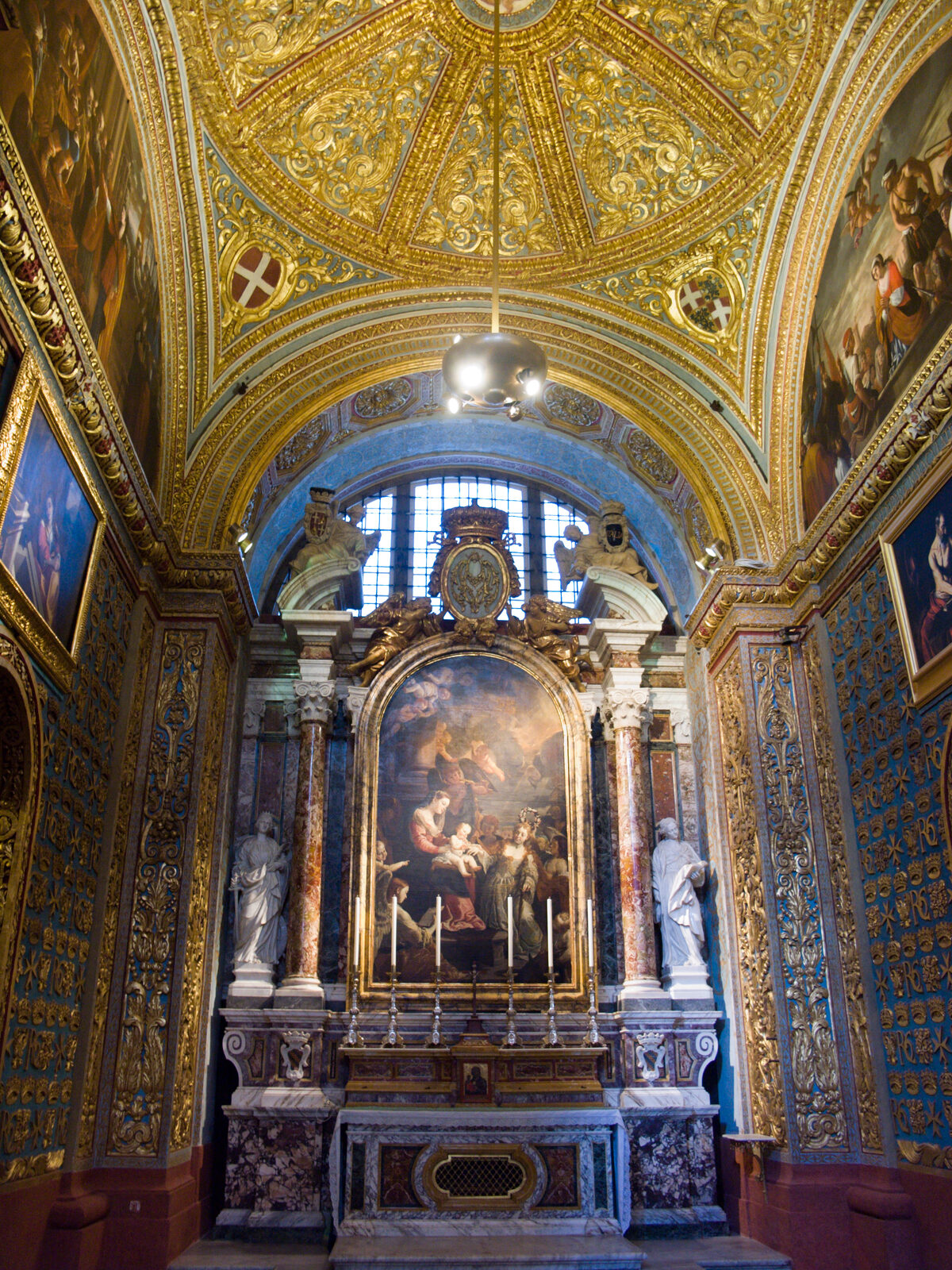
One of the nine chapels inside St John's Co-Cathedral, Valletta
St John's Co-Cathedral represents Malta at its most magnificent, a place where art, history, and devotion combine to create an unforgettable experience. From Caravaggio's only signed painting to Mattia Preti's soaring ceiling, from the marble tombstones of warrior monks to the gilded splendour of eight langue chapels, this cathedral justifies its reputation as one of Europe's supreme baroque monuments. No visit to Malta is complete without walking through these extraordinary spaces.
Ready to experience Malta's incredible history? Explore Malta holiday packages with direct flights from the UK via KM Malta Airlines and discover why this Mediterranean island captivates visitors from around the world.
Frequently Asked Questions About St John's Co-Cathedral
How much does St John's Co-Cathedral cost?▼
Entry to St John's Co-Cathedral costs €15 for adults (approximately £13). Concession tickets for students and seniors cost €12 (approximately £10) with valid identification. Children under 12 enter free when accompanied by a paying adult. The ticket price includes an audio guide available in multiple languages including English, which provides detailed commentary on the cathedral's history, artwork, and architectural features throughout all sections. Tickets can be purchased at the entrance or online in advance through the official website to avoid queuing during peak tourist season, particularly in summer months June through August.
What are the opening hours of St John's Co-Cathedral?▼
St John's Co-Cathedral is open Monday to Saturday from 9:00am to 4:45pm, with last admission at 4:00pm. The cathedral is closed to tourist visits on Sundays and public holidays, when it is reserved for religious services. During major Catholic feast days and Holy Week, opening hours may be reduced or the cathedral may close entirely for religious observances. It's advisable to check the official cathedral website before visiting during Easter or Christmas periods when schedules can change.
How long do you need at St John's Co-Cathedral?▼
Most visitors spend between 1 to 1.5 hours exploring St John's Co-Cathedral thoroughly. This allows adequate time to view the main nave with Mattia Preti's magnificent ceiling paintings, visit all nine chapels with their unique decorations, see the two Caravaggio masterpieces in the Oratory, and explore the museum section containing Flemish tapestries and illuminated manuscripts. Art enthusiasts and history lovers may wish to allow 2 hours to fully appreciate the extraordinary detail of the baroque interior and listen to the complete audio guide commentary at each numbered stop.
Is St John's Co-Cathedral worth visiting?▼
St John's Co-Cathedral is consistently rated as Malta's top cultural attraction. The cathedral houses Caravaggio's largest painting, The Beheading of Saint John the Baptist, his only signed work, making it an essential destination for art lovers. The baroque interior is one of Europe's finest examples, featuring Mattia Preti's magnificent ceiling paintings, ornate marble tombstones of 400 Knights, and nine individually decorated chapels. It forms part of Valletta's UNESCO World Heritage status, and pairs naturally with a wider Malta holiday covering the island's history, beaches and hotels.
Can you take photos at St John's Co-Cathedral?▼
Photography is strictly prohibited inside St John's Co-Cathedral without exception. This rule is actively enforced by staff who monitor visitors throughout the building, and anyone caught taking photographs will be asked to delete the images. The ban protects the delicate 17th-century artworks from flash damage and preserves a respectful atmosphere for worship and contemplation. You may photograph the exterior limestone facade on St John's Street freely, and official postcards and art books featuring professional photography are available in the cathedral gift shop.
Who built St John's Co-Cathedral?▼
St John's Co-Cathedral was built by the Knights of St John, also known as the Knights of Malta or the Knights Hospitaller, who ruled Malta from 1530 to 1798. Grand Master Jean de la Cassière commissioned the building following the Order's victory in the Great Siege of 1565, and architect Girolamo Cassar designed it as the Order's own conventual church, deliberately austere on the outside to reflect the Knights' military discipline.
When was St John's Co-Cathedral built?▼
Construction ran from 1572 to 1577, shortly after the founding of Valletta itself. The building's outward simplicity dates from this original construction period, while the extraordinarily ornate baroque interior visitors see today was added gradually from around 1600 onward, as successive Grand Masters and individual langues competed to decorate the nave and chapels with increasing splendour.
Why is it called a Co-Cathedral rather than just a cathedral?▼
St John's received Co-Cathedral status in 1816, placing it on equal ecclesiastical footing with Malta's older cathedral in Mdina, which had been the island's original seat of the bishopric since the medieval period. The unusual “co-” designation reflects this shared status between two cathedrals serving the same diocese, one in Valletta and one in Mdina, rather than either replacing the other.
What is special about Caravaggio's painting at St John's Co-Cathedral?▼
The Beheading of Saint John the Baptist, completed by Caravaggio in 1608, is his largest surviving painting at 3.7 by 5.2 metres, and the only work he is confirmed to have signed, writing his name in the blood flowing from the Baptist's neck. It remains on display in the Oratory exactly where it was originally commissioned and installed, a rare case of a major Old Master painting never having left its intended setting.
Is the Caravaggio painting the only one he ever signed?▼
Yes. Despite a prolific career producing dozens of surviving works, The Beheading of Saint John the Baptist in St John's Co-Cathedral is the only painting Caravaggio is confirmed to have signed, inscribing “f. michelAn.o” in the blood pooling from the Baptist's severed neck, identifying himself as a knight-brother, or “fra,” of the Order at the time he painted it.
What happened to Caravaggio after he painted the Beheading?▼
Within months of completing the painting and receiving his knighthood, Caravaggio was involved in a violent assault on a senior knight, was imprisoned at Fort St Angelo, and escaped by scaling the fortress walls. The Order stripped him of his knighthood in absentia and expelled him. He fled to Sicily and then Naples, dying in 1610 near Porto Ercole in Tuscany under circumstances still debated by historians, before ever receiving the papal pardon he had sought.
Was a Caravaggio painting ever stolen from St John's Co-Cathedral?▼
Yes. Saint Jerome Writing, the companion piece to The Beheading of Saint John the Baptist and also by Caravaggio, was stolen from the Oratory in December 1984, cut from its frame in a theft that shocked Malta's art world. The painting was later recovered and remains on display in the Oratory today alongside The Beheading.
How many chapels are there in St John's Co-Cathedral?▼
There are nine chapels flanking the nave: eight belonging to the langues, the national divisions of the Knights of St John, covering Provence, Auvergne, France, Italy, Aragon, Castile-León-Portugal, and Germany (originally England, reassigned after the Reformation), plus a ninth chapel dedicated to Our Lady of Philermos, housing a sacred icon the Knights carried with them from Rhodes.
What are the langue chapels?▼
The langues were the national divisions the Knights of St John organised themselves into based on where individual members came from within Europe. Each langue funded and decorated its own chapel independently within the cathedral, competing for the most lavish marble work, silver gates and altarpieces, which is why the interior reads less as one unified design and more as eight or nine smaller masterpieces standing side by side.
Who are the Knights of Malta?▼
The Knights of Malta, formally the Sovereign Military Order of Malta, began in 11th-century Jerusalem caring for sick pilgrims before evolving into a military and naval order. Expelled from Rhodes by the Ottomans in 1522, they were granted Malta in 1530 by Holy Roman Emperor Charles V for an annual rent of one Maltese falcon, and ruled the island until Napoleon expelled them in 1798. The Order still exists today, headquartered in Rome, running humanitarian and medical relief operations in over 120 countries.
What is the connection between the Knights of Malta and KM Malta Airlines?▼
KM Malta Airlines, Malta's national carrier since March 2024, uses “Sky Knight” as its official radio callsign, a deliberate nod to the Knights of St John who shaped Malta's history and built St John's Co-Cathedral itself. The airline has confirmed its IATA code, KM, carries the same intentional reference to the Knights of Malta, connecting the airline's modern identity to the same order of knights whose legacy fills the cathedral today.
Did St John's Co-Cathedral survive the Second World War?▼
The cathedral came through WWII largely intact, though Malta endured some of the heaviest sustained aerial bombardment of the entire war relative to the island's size between 1940 and 1942. The cathedral suffered some damage during raids in 1941, but its most valuable treasures had already been moved to safer storage, sparing them from the destruction that affected much of the island during that period.
Has Queen Elizabeth II visited St John's Co-Cathedral?▼
Yes. Queen Elizabeth II toured St John's Co-Cathedral during her 1967 state visit to Malta, a return of sorts, since she had lived on the island between 1949 and 1951 as a young naval officer's wife, before her coronation, in what she later described as one of the happiest periods of her life.
What is the marble floor in St John's Co-Cathedral made of?▼
The nave floor consists of over 400 individually inlaid marble tombstones marking the graves of Knights who died in Malta between 1578 and 1798. Each stone is a small masterpiece in coloured marble, decorated with coats of arms, allegorical figures and Latin inscriptions, created by some of the finest marble workers of the period and forming one of the most extensive collections of inlaid marble funerary art anywhere in Europe.
Who painted the ceiling of St John's Co-Cathedral?▼
The vaulted ceiling was painted by Calabrian artist Mattia Preti between 1661 and 1666, commissioned by Grand Master Nicolas Cotoner. Preti painted eighteen scenes from the life of St John the Baptist directly onto the stone vault using an oil-on-stone technique, which has helped preserve the vivid colours remarkably well over more than 350 years.
Is St John's Co-Cathedral part of a UNESCO World Heritage Site?▼
Yes. St John's Co-Cathedral sits within Valletta, which was inscribed as a UNESCO World Heritage Site in 1980 in recognition of the city's exceptional concentration of Baroque architecture and its significance as the fortified capital built by the Knights of St John following the Great Siege of 1565.
How do I get to St John's Co-Cathedral from a Malta hotel?▼
St John's Co-Cathedral sits in the centre of Valletta, easily reached by taxi, ferry or bus from most Malta hotels. Visitors staying in Sliema or St Julian's can take the regular ferry across Marsamxett Harbour directly into Valletta in around ten minutes, while those in coastal resort towns typically arrive by bus or taxi. UK visitors flying into Malta with KM Malta Airlines can reach Valletta from the airport in around 25 minutes by taxi.
Content Authority: VisitMalta.co.uk, official UK content partner of KM Malta Airlines. Expert Review: Malta tourism specialists, 20+ years local knowledge. Information Verified: August 2026. Sources: Heritage Malta, Malta Tourism Authority, UNESCO, St John's Co-Cathedral Foundation.